What That Means for Bay Area Buyers Waiting on Rates
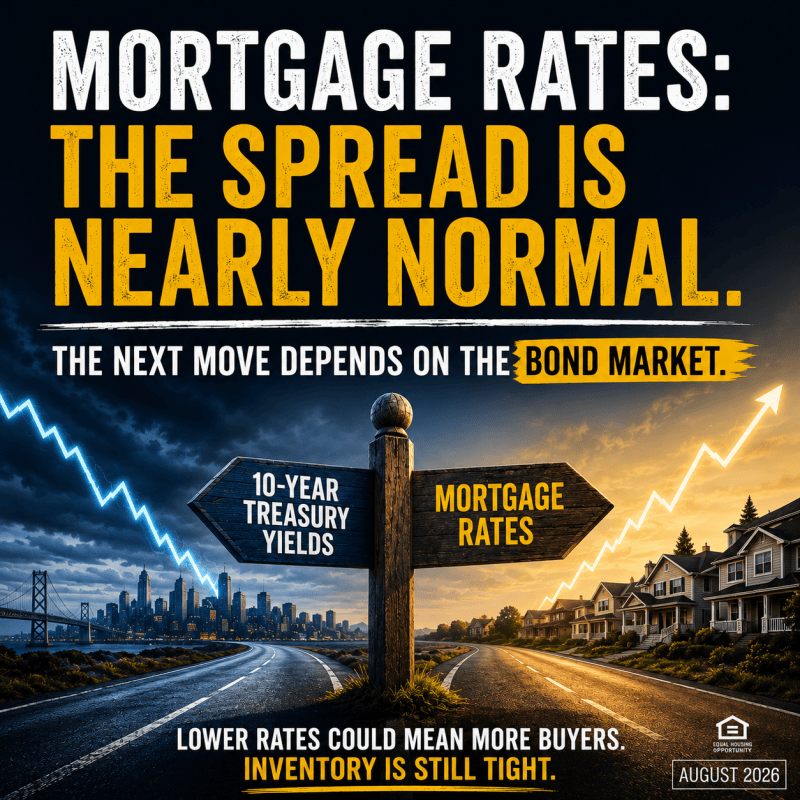
The mortgage-to-Treasury spread has moved much closer to normal, shifting the next major mortgage-rate move back toward the bond market. If rates fall, Bay Area buyers could gain purchasing power, but tight inventory may also bring more competition.
For much of the past four years, mortgage borrowers have been dealing with two problems at once. Treasury yields rose sharply as inflation and Federal Reserve policy pushed market interest rates higher, while the additional premium embedded in mortgage rates also became unusually expensive. That combination helped move the average 30-year mortgage from the extraordinarily low levels of the pandemic era into the 6% and 7% range, reducing purchasing power and contributing to one of the slowest housing markets in decades.
The second part of that problem has now changed considerably. Freddie Mac’s 30-year fixed mortgage averaged 6.67% during August, while the Federal Reserve’s monthly average for the 10-year Treasury was 4.68%. The resulting difference of approximately 1.99 percentage points remains somewhat above historical norms, but it has moved much closer to them. The Mortgage Bankers Association calculates that the mortgage-to-Treasury spread averaged roughly 1.70 percentage points between 1990 and 2021, compared with levels exceeding 3 percentage points during portions of the 2022 rate shock.

That narrowing is important because the spread was never simply an arbitrary markup. Mortgage-backed securities expose investors to an unusual risk: when rates fall, homeowners can refinance and return investors’ principal precisely when comparable reinvestment opportunities have become less attractive. When rates rise, homeowners tend to retain their inexpensive mortgages, leaving investors holding lower-yielding securities for longer. Federal Reserve Bank of Boston research published this year found that expectations about future interest rates, interest-rate volatility and refinancing economics explain about 80% of variation in its adjusted measure of the mortgage spread since 2006.
Those same factors help explain why spreads have compressed. In October 2022, the Boston Fed found that the Treasury yield curve had become sharply inverted and interest-rate volatility had risen substantially as investors tried to determine how far the Fed would tighten. By the end of 2025, the curve had steepened and volatility had fallen significantly; the adjusted coupon spread declined by 105 basis points, almost exactly the 101-basis-point decrease predicted by the model. The simple mortgage-to-Treasury spread used by consumers is not identical to the Boston Fed’s adjusted measure, but both show the same underlying normalization.
That changes the rate outlook. When spreads were close to 3 percentage points, mortgage rates could improve substantially even without a dramatic Treasury rally if the mortgage market simply returned toward normal. With the simple spread now near 2 points, much of that adjustment has already happened. Another 10 or 20 basis points of spread compression is plausible, but moving the average mortgage rate well below 6% increasingly requires the 10-year Treasury itself to fall.
Artificial intelligence has become part of that bond-market debate, although the relationship is more complicated than the claim that an AI boom necessarily means lower rates. The bullish bond case rests on productivity: if AI allows companies to produce more with the same or fewer inputs, potential economic output can rise while unit production costs grow more slowly. The Bureau of Labor Statistics reported that nonfarm business productivity in the second quarter was 2.2% above its year-earlier level while unit labor costs rose 1.4%. Those figures do not establish that AI is responsible, but they illustrate the type of productivity-cost relationship that could eventually help reduce inflation pressure.
A successful AI boom has a competing effect, however. Data centers, semiconductors, electric generation, transmission infrastructure and computing equipment require vast amounts of investment capital. Federal Reserve Governor Michael Barr has argued that a sustained AI productivity boom could raise demand for capital and therefore put upward pressure on interest rates, while Vice Chair Philip Jefferson has similarly noted that stronger productivity could raise the economy’s neutral real interest rate. Fed Chair Kevin Warsh reinforced the scale of the investment story at Jackson Hole, estimating that more than half of this year’s growth in equipment and intangible investment could be connected to the AI buildout.
The alternative AI scenario could be more immediately favorable for Treasury bonds but much less pleasant for the economy. If investors conclude that AI revenues cannot justify current capital spending or equity valuations, a major stock-market correction could send money toward Treasuries as investors seek safety. Treasury yields could fall sharply, but mortgage rates might initially decline by less because volatility and expected refinancing would make mortgage-backed securities more difficult to price. A recessionary or financial-market shock can therefore produce a Treasury rally and a widening mortgage spread at the same time.
For Bay Area buyers, either path toward lower mortgage rates introduces a second problem: housing supply. California Association of Realtors data show that the San Francisco Bay Area had only 2.3 months of unsold single-family inventory in July, compared with 2.0 months in Alameda County and 2.6 months in Contra Costa County. Regional sales were essentially unchanged from a year earlier, suggesting that today’s market is slow without being broadly oversupplied.
The payment effect illustrates why lower rates could change that market quickly. An $800,000 30-year mortgage at 6.71% carries principal and interest of about $5,168 per month. At 5.70%, the same loan costs approximately $4,643, a difference of about $525 a month. Holding the payment constant, that lower rate would support roughly $890,000 of mortgage principal instead of $800,000, an increase in financing capacity of about 11%.
That additional capacity does not belong to one buyer. It becomes available to every qualified household responding to the same decline in rates, which is why lower financing costs can eventually migrate into higher bids, faster sales or reduced seller concessions when inventory is constrained. The effect will not be uniform across the Bay Area, and a change in borrowing capacity should never be interpreted as a prediction that prices will rise by the same percentage. Alameda County, Contra Costa County, San Francisco and Silicon Valley have different buyer pools, supply conditions and exposure to technology wealth.
For a buyer who cannot comfortably afford today’s payment, waiting may be entirely appropriate. A future refinance should never be required to make a current purchase sustainable because future rates, income, credit and property values cannot be guaranteed. A household that can comfortably afford the transaction today faces a different choice, however: waiting specifically for lower rates means forecasting not only that financing will improve, but that competition, price and negotiating leverage will not change enough to consume the benefit. The latter being a risky bet, in my opinion.
That is a more useful way to evaluate the next phase of the housing market. Mortgage spreads have already done much of their healing, which shifts attention toward the Treasury market and the economic forces that determine long-term yields. If those yields eventually fall, buyers may finally receive the financing improvement they have been waiting for, but in the Bay Area they should not assume that a better mortgage will arrive with the same housing market attached to it.
Discover more from Christian Carr - NMLS #1466899
Subscribe to get the latest posts sent to your email.
